
Canadian Government to Implement New Refugee Rules on December 15th

A refugee camp in Chad. New refugee rules will allow for a more comprehensive appeals process for asylum claimants from countries with a history of rights abuses while using an expedited process for claimants from safer countries like EU member states (Mark Knobil)

Citizenship and Immigration Canada (CIC) announced on Friday that new rules to clamp down on abuse of Canada’s refugee program will come into force on December 15th.

The new rules are a reaction to an increase in bogus asylum claims that have seen tens of thousands of individuals from comparatively safe countries apply for refugee status in Canada and typically abandon their refugee claim before their hearing with the Immigration and Refugee Board (IRB), but not before collecting thousands of dollars worth of welfare and free health care while in Canada.

Under the revised asylum claims processing rules, cases will be heard within 60 days, instead of the 600 days it currently takes on average. A Refugee Appeal Division (RAD) will also be created to allow asylum claimants from countries with a history of persecution to appeal negative decisions by the IRB.

To deal with bogus asylum claimants delaying their deportation through a long process of appeals, a separate processing stream will be created for claimants from ‘designated countries of origin’ (DCOs), which are those countries with comparatively strong legal protections of human rights, and these claimants will have fewer and more expedited options to appeal negative decisions by the IRB.

The creation of a ‘safe list’ of countries for expedited processing mirrors the protocol that the governments of most Western countries have in place to reduce the cost of processing bogus refugee claims.

Commenting on the changes, Citizenship and Immigration Minister Jason Kenney said, “last year alone, nearly a quarter of all asylum claims in Canada were made by people from democratic European Union nations – that’s more claims than Canada received from Africa or Asia. We’re spending far too much time and taxpayers’ money on bogus claims, and on generous tax-funded health and social benefits for claimants from liberal democracies.”

“Sixty-two percent of all asylum claims – and virtually all asylum claims for the European Union – were either abandoned or withdrawn by the claimants themselves or rejected by the IRB last year,” Kenney added.

“It became abundantly clear that our system needed to be changed. These changes will move our asylum system from one that allows bogus claimants to rely on loopholes and redundant appeals to delay their removals for several years, to a system that hears claims quickly and removes bogus claimants faster. That is in the best interest of Canada, and of legitimate refugees. Canada’s asylum system is one of the most generous in the world and will continue to be under the new and improved system.”

Government Report Recommends Increasing Immigration Levels in 2014

The internal government review finds that Australia’s experience suggests that basing immigration admittance on employment offers does not produce better results

The seven year freeze on increases in immigration levels beyond 253,000 should be lifted in 2014, according to an internal government review obtained by Postmedia News:

The study, dubbed a “Literature review and expert advice to inform Canada’s immigration levels planning,” suggests immigration levels should begin increasing six per cent a year to approximately 337,000 in 2018, after which levels should plateau until 2021, the end of the review period.

The report says that labour needs, based on economic projections, necessitate the increase.

Immigration levels as a percentage of Canada’s population have steadily fallen over the last seven years as the country has experienced population growth without a corresponding increase in the number of immigrants admitted.

Recent public opinion polls have indicated that the majority of Canadians oppose an increase in immigration levels, and this, along with recent studies showing a growing income gap between recent immigrants and native born Canadians, have encouraged the federal government to resist calls to increase immigration levels.

According to the Postmedia News report, the internal review calls for greater research into factors hampering the economic integration of immigrants and into comparisons between the economic performance of immigrants who enter through the federal skilled worker program and that of immigrants who enter through provincial nominee programs (PNPs).

The review also recommends against increasing the proportion of immigrants admitted through the PNPs, which clashes with calls from provincial governments to give them greater control over selecting the immigrants that enter Canada.

Canadian Farmers Income Increased by 53% in 2011

Canada's prairie provinces produce the majority of agricultural products in Canada. The province of Saskatchewan is sometimes known as the 'breadbasket' of the country for producing nearly 60 percent of grain grown in the country

Canadian farm income increased by 53 percent in 2011 from 2010 according to Statistics Canada. Realized net income, meaning farm income after operating expenses and depreciation, amounted to $5.7 billion last year, with farmers making gains despite a large increase in costs.

The 2011 gains follow a 19 percent increase in income in 2010 and a 19.6 percent decline in 2009 following the global financial crisis.

Agriculture and agrifoods is an important sector of the Canadian economy, accounting for 8 percent of its GDP, over $40 billion in export revenue, and nearly one in eight jobs in the country.

Canada is one of the largest agricultural producers in the world. Its prairie provinces: Alberta, Saskatchewan and Manitoba, produce a bulk of the agricultural products in the country. Nearly 60 percent of Canadian grain is grown in Saskatchewan, while nearly 50 percent of Canadian beef is produced in Alberta.

The prairie provinces have outperformed the rest of Canada in economic growth over the last several year and have among the best labour markets in North America.

Provincial Premiers Call For Greater Say in Canadian Immigration

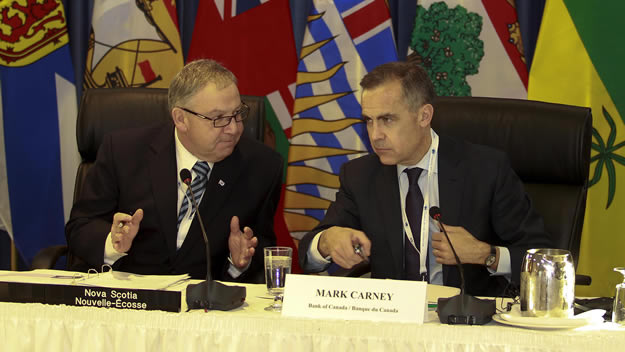
Nova Scotia Premier Darrell Dexter and Bank of Canada Governor Mark Carney at the two day economic forum (Province of Nova Scotia)

The premiers of Canada’s provincial and territorial governments concluded a forum on economic development in Halifax today with a joint-call on the federal government to give them greater control over immigration.

“We want to become masters of our own destiny when it comes to the immigration file. Nobody better understands our needs and our capacity to accommodate and our capacity to develop new Canadians so they can develop to their fullest,” said Ontario Premier Dalton McGuinty at today’s news conference.

British Columbia Premier Christy Clark added: “We want more space to be able to make our decisions about which immigrants will come to our provinces, where they will be settled and how many we’ll get.”

Quebec has had an independent immigration program since the 1970s, but the other provinces only started being delegated immigration selection powers over the last decade with the signing of several federal-provincial agreements creating Provincial Nominee Programs (PNPs).

While the number of provincial nominees has grown seven fold since 2004, with 42,000 to 45,000 individuals expected to immigrate under a PNP in 2012, the pace of change is not fast enough for the provinces, who want to select a greater share of the approximately 250,000 individuals who are admitted into Canada as permanent residents each year.

The provincial premiers say that being able to select their own immigrants gives them more power to control the direction of their economic development by selecting those individuals that have the skills to meet their regional labour shortages, which they say their governments are best positioned to assess.

The two-day economic forum was hosted by the Council of the Federation, an institution created by the provincial and territorial governments to facilitate collaboration between their respective governments.

The forum saw presentations from Bank of Canada Governor Mark Carney and Professor of Economics at George Mason University, Tyler Cowen, author of The Great Stagnation.

Canada and EU Working Toward Free Trade Agreement

Canada could see more energy exports to the EU if it finalizes a free trade agreement with the economic block this week

Canada and the EU are close to finalizing a Free Trade Agreement (FTA) that would be the EU’s first with a G7 country. Canadian Trade Minister Ed Fast is meeting his EU counterpart in Brussels in talks this week to negotiate an agreement on the remaining issues.

Among the areas where differences still exist between the parties are agriculture market access, intellectual property standards relating to the pharmaceutical industry, procurement at the provincial and municipal-government level, and investor protection through arbitration rules.

Canada-EU trade amounts to $67 billion a year, with Canada chiefly exporting natural-resource intensive industrial goods like steel, manufactured goods like machinery and transport equipment, chemical products, and energy products to the EU, and the EU exporting a similar mix, with less energy and more machinery and transport equipment, to Canada.

Both economic blocks stand to gain from an increase in bilateral trade due to returns to scale. A joint-study in 2008 projects a $14.9 billion gain in annual income for the EU and a $10.5 billion annual gain for Canada from a FTA.

Canada currently has FTAs with fourteen countries and has an economy that is heavily reliant on external trade.

Court Forces Canadian Province to Reveal Names of Companies Involved in Immigrant Investor Program

Immigrants invested an estimated $120 million into PEI-based businesses through the PEI PNP Investor Program in 2007 and 2008 before it was shut down in 2009

A Provincial Crown Corporation responsible for managing Prince Edward Island’s (PEI) Provincial Nominee Program (PNP) was ordered by a court this month to release a list of 1,423 businesses that were approved to receive funding from immigrant investors.

The Crown Corporation, Island Investment Development Inc (IIDI), was initially successful in blocking requests under the Freedom of Information and Protection of Privacy Act (FOIPPA), by applicants that included the CBC, Canada’s largest news broadcaster, for it to release the names of the businesses that it approved to receive investments through a now defunct “Immigrant partner” stream of the PEI PNP.

Under the Immigrant partner component of the PNP, the government of PEI would grant nominations for Canadian permanent residence to immigrants who made a $200,000 investment into a qualified PEI business and who had a net worth of at least $400,000.

PEI’s privacy commissioner ruled that disclosure of the names of the businesses and the number of PNP investment units that each received through the program would violate the FOIPPA by revealing financial information about the companies that they had a reasonable expectation of remaining confidential when they applied for the program.

The CBC subsequently appealed to the PEI Supreme Court to over-turn the privacy commissioner’s decision, and on November 2nd, the court did just that for one portion of the CBC’s request: the release of the names of the businesses.

The privacy commission’s decision to uphold IIDI’s refusal to release the number of investment units it approved for each company was upheld by the presiding judge, Justice Wayne Cheverie, as he argued that the minimum net worth of the concerned companies could be deduced from this information, given it was a criteria for eligibility under the program.

The list of companies was posted online by the CBC, and can be found here.

PEI currently has an active immigrant investor program, but unlike the Immigrant partner program which allowed for an unlimited number of nominations, the current program is capped at 400 applications per year.

Federal Gov of Canada Increases Nova Scotia’s Immigration Nominee Quota

Nova Scotia will be able to nominate 700 applicants and their families for immigration to Canada in 2012 after the cap for its Provincial Nominee Program was increased by 200

Nova Scotia’s provincial government announced yesterday that the federal government has increased the province’s immigrant nominee cap by 200, to 700 nominations in 2012.

“It will help us address existing and expected labour shortages,” said Marilyn More, the provincial minister responsible for Nova Scotia’s Office of Immigration. She said that the province would push for further increases of its Provincial Nominee Program (PNP) quota.

PNPs allow Canadian provinces and territories to nominate individuals who they deem as likely to contribute to their economy for immigration to Canada. The first PNP was created for Manitoba in 1998, and quickly expanded to all other provinces.

The federal government, which has jurisdiction over immigration in Canada, caps the number of individuals each province can nominate for Canadian permanent residence each year, but that number has steadily increased, amid repeated appeals by provincial premiers for expansions of their PNPs, which they say allow them to select the immigrants that best meet their provinces’ unique economic needs.

While the federal government has indicated it would continue to expand the PNPs, it has also expressed concern about the standards some provincial government use when nominating individuals. In July, it instituted minimum language requirements for PNP applicants in low/semi-skilled occupations.

Under the new language rules, applicants in occupations that are classified as NOC Skill Level C or D must prove English or French proficiency of at least Canadian Language Benchmarks (CLB)/Niveaux de compétence linguistique canadiens (NCLC) 4, in all categories: listening, speaking, reading and writing.

The required International English Language Test System (IELTS) test scores to meet CLB 4 are 4.0, 4.5, 3.5, and 4.0 for listening, speaking, reading and writing, respectively.

Canadian Prime Minister Lays Out His Vision For Immigration To Canada

Prime Minister Stephen Harper told the Globe and Mail that Canada will need to compete for high value immigrants as other country look to immigration to solve their fiscal problems

In an interview on Saturday with the Globe and Mail, Canada’s largest national newspaper, Prime Minister Stephen Harper expounded in length on his vision for Canada’s immigration programs.

He told the Globe that competition for skilled international workers would heat up over the coming years, as “the demographic changes .. the aging population, start to bite, in many developed countries”.

He trumpeted his government’s achievements in reforming what he called the old “passive pro-immigration policy” which “operated on receiving applications and processing them in order” and had left his government with “backlogs of hundreds and hundreds of thousands of applications”.

He said his government is trying to shift to an “activist policy” where Canada goes out and recruits the immigrants it needs, and when it receives applications, “prioritize them to the country’s objectives.”

The Prime Minister said that as the rest of the developed world increases its immigration intake, Canada would need the activist immigration policy to “compete, and make sure we get the immigrants both in terms of volumes and particular attributes: skills, expertise and investment capacity.”

Under the Conservative government, Citizenship and Immigration Canada (CIC) has legislatively wiped out the 280,000 application Federal Skilled Worker (FSW) program backlog, and frozen acceptance of new applications under both the FSW program and the Federal Immigrant Investor program as it re-designs the programs and reduces the backlogs.

CIC has also suspended the parent and grandparent sponsorship programs and replaced them with a ‘Super Visa’ that allows foreign parents and grandparents of Canadian citizens and landed immigrants to visit Canada for up to ten years.

Immigration Department: 1 Year Canadian Experience Class Launching Jan 2013

Citizenship and Immigration Minister Jason Kenney tweeted more details in recent days about coming changes to the Canadian Experience Class and Federal Skilled Worker programs

The length of time that a temporary foreign worker needs to have worked full-time in the Canada to qualify for permanent residence under the Canadian Experience Class (CEC) immigration program will be reduced from 24 months to 12 months in January 2013, according to a tweet by Citizenship and Immigration Minister Jason Kenney.

The long expected change in the CEC program’s work experience requirement is intended to increase the share of immigrants that come through the program, as Citizenship and Immigration Canada (CIC) considers immigrants with Canadian work experience as more likely to be successful in integrating into Canada’s labour market than those who are admitted under more traditional routes like the Federal Skilled Worker (FSW) program.

The announcement on the date of the CEC program rule change was made in a response to a tweet directed to Kenney, who is quite active on the micro-blogging site, on November 5th:

@KaushikJay The new 1 year threshold for high-skilled temporary foreign workers to qualify for CDN Experience Class will start January, 2013

In a series of tweets on November 4th, Kenney also described when and in what form the revamped FSW program will be launched.

He posted that the final details for the relaunched program would be released in the “1st half of 2013” and that there would only be “a very limited number of new applications” accepted in 2013, to help CIC “asses [sic] the new grid & educational evaluation”.

He also posted that CIC’s goal was to launch the new Expression of Interest model for the FSW program “around late 2014 / early 2015”.

CIC placed a moratorium on accepting new applications through the FSW program in July 2012, to give it time to deal with the program’s pending application backlog and to design new selection rules and assessment procedures that it says will make the program more economically beneficial for Canada and its application review process faster.

Immigration Minister Calls on Regulators to Reduce Barriers for Canada’s Immigrants

Citizenship and Immigration Minister Jason Kenney is seeking the cooperation of Canada's self-regulatory organizations in making it easier for new Canadians to get licensed to work in their field in Canada

Citizenship and Immigration Minister Jason Kenney attended the annual conference for Canada’s self-regulatory organizations (SROs) today and asked for their cooperation in helping recent immigrants to Canada become licensed in their field.

The Canadian Regulators Conference, held in Ottawa on November 8th and 9th, is organized by the Canadian Network of National Associations of Regulators (CNNAR), an association made up of some of Canada’s largest SROs, including the Canadian Nurses Association, the Ontario College of Teachers, and the Federation of Medical Regulatory Authorities of Canada.

CNNAR’s annual conferences are intended to foster information sharing on strategies and best practices among regulatory organizations, and are likely seen by Citizenship and Immigration Canada (CIC) as an ideal platform to promote its message of the need to increase regulatory recognition of foreign credentials and licensing of foreign-trained professionals.

Canada’s SROs have been under some criticism recently for occupational regulations that have hampered the labour market integration of Canada’s immigrants.

A report from the Canadian Labour Market and Skills Researcher Network (CLSRN) this month estimates that licensure barriers that prevent immigrants from working in their field of study cost the Canadian economy $2-5.9 billion a year in lost productivity and tax revenue.