Canada Ranks 5th in World Ranking of Economic Freedom, US Falls to 18th

Canada is now ranked as having the freest economy in North America, thirteen places ahead of the United States, the historic symbol of economic freedom in the world (NASA/GSFC)

Canada tied Australia for fifth freest economy in the world in the Fraser Institute’s annual Economic Freedom of the World report, released yesterday. Canada improved its position by one spot while the US saw its ranking drop by ten spots from last year’s index.

The Fraser Institute’s economic freedom index scores countries’ degree of economic freedom by five criteria:

  1. Size of Government- a measure of how much government spends as a percentage of GDP, how much of the economy is directed by government-managed firms rather than the private sector, and income and payroll tax rates.
  2. Legal System and Property Rights- the extent to which private property ownership rights are protected and contracts are enforced by an independent judiciary and impartial court system.
  3. Sound Money- how well a country’s central bank maintains a low and stable inflation rate, and the freedom of people in a country to user alternative currencies and foreign bank accounts.
  4. Freedom to Trade Internationally- the degree of freedom people in a country enjoy from international trade barriers set up by their governments.
  5. Regulation- the extent of freedom from government restrictions on mutually voluntary activities. Countries with fewer regulations like minimum wage restrictions, dismissal regulations, and mandatory acceptance of collective bargaining requests score higher in this area.

The economic data used in the index is from 2010, as that is the most recent comprehensive data available, and comes from external sources like the International Monetary Fund, World Bank, and the World Economic Forum.

For the sixteenth year in a row, Hong Kong and Singapore ranked first and second place in the index. The two East Asian economies have the lowest levels of government spending in the industrialized world, at approximately half that of Canada as a percentage of GDP, and the fewest restrictions on trade, labour and business activities of any of the 144 countries and territories included in the index.

Like most industrialized countries, Canada received a low score in the Size of Government component, ranking 73rd in the world, due to high levels of government spending and high marginal tax rates, but ranked near the top of the index in the areas of Legal System and Property Rights (12th), and Regulation (6th), thanks to a strong rule of law providing secure rights to property, and few regulatory barriers in credit markets and on labour and business activities.

The US’s overall ranking suffered due to an increase in government spending, and a reduction in its scores in the areas of Rule of Law and Freedom to Trade Internationally.


Edmonton and Calgary to Have Fastest Economic Growth in Canada

Suncor Energy Centre in Calgary, Alberta. Edmonton and Calgary are expected to have the fastest economic growth in Canada according to the Conference Board of Canada’s Metropolitan Outlook-Autumn 2012 (Chuck Szmurlo)

The Albertan metropolises, Calgary and Edmonton, will have the fastest economic growth in Canada this year, followed closely by Regina, Saskatchewan, according to a forecast by the Conference Board of Canada’s Metropolitan Outlook-Autumn 2012, released today.

Alberta is expected to benefit from high levels of energy-industry-related investment for the next four years, which will help fund economic growth of 3.8 percent in Calgary and 4.6 percent in Edmonton in 2012.

Saskatchewan’s cities, also enjoying a resource-sector-led boom thanks to the province’s large oil and gas, potash, uranium, and lumber resources, will see strong growth over the next four years according to the report. The provincial capital, Regina, is expected to lead the province with economic growth of 3.6 percent in 2012.

Perhaps surprisingly given the city’s real estate slowdown, Vancouver is expected to have one of the best performing economies in Canada in the coming years, with economic growth of 3.1 percent in 2012, and average annual economic growth of 3.3 percent forecast for the next four years.

Bank of Canada Governor: Commodities ‘Unambigiously Good’ For Canada

Spruce Meadows, south of Calgary, where Bank of Canada Governor Mark Carney was a marquee speaker for the annual Spruce Meadows Changing Fortunes Round Table

Wading into a national debate that was ignited by a controversial claim by Thomas Mulcair, leader of Canada’s left-leaning National Democratic Party (NDP), that Canada’s booming resource sectors harm the overall Canadian economy- the so-called ‘Dutch Disease’ hypothesis, Bank of Canada Governor Mark Carney on Friday strongly rejected the notion and endorsed the view that high commodity prices are a net benefit to the Canadian economy.

The Dutch Disease argument Mulcair first put forth in April is that higher revenues from Western Canadian oil exports have increased the value of the dollar, which has made Canadian manufacturing less competitive in international markets, and that in the long-run, the contribution made by the resource sectors to the Canadian economy does not make up for the resultant decline in manufacturing.

In a presentation given to the annual Spruce Meadows Changing Fortunes Round Table near Calgary, an event that attracts business leaders from across Canada, Carney roundly dismissed the argument, saying “the [Dutch Disease] diagnosis is overly simplistic and, in the end, wrong.” He added that “Canada’s economy is much more diverse and much better integrated than the Dutch Disease caricature”, and that much of the decline in manufacturing is not related to the rising value of the dollar.

Carney provided the following chart to demonstrate that the decline in Canadian manufacturing’s share of GDP “is part of a broad, secular trend across the advanced world” as opposed to a Canadian peculiarity owing to the country’s natural resource wealth:

Carney said that an analysis done by the Bank of Canada using its Terms-of-Trade Economic Model (ToTEM) projects that the economic effect of a 20 percent increase in oil prices would be positive for Canada under all three scenarios modelled:

Stronger demand from the U.S. would contribute to a 3 percent increase in GDP over five years. Stronger demand from Asia, as is the case now, would boost GDP by 1 percent over the same time frame, and a short term supply shock would increase GDP by 0.2 percent in the first year.

Maximizing Returns

Carney said that to increase the benefit that Canada derives from high commodity prices, the country should shift “export markets toward fast-growing emerging markets”, in particular in the Asia Pacific region, as U.S. growth had slowed and would likely stay muted for the foreseeable future.

He also prescribed that the country build “new energy infrastructure—pipelines and refineries” to bring Western Canadian oil to Eastern Canadian consumers, who are now importing oil and paying an average premium of $35 over the price in Western Canada. The infrastructure would bring “more of the benefits of the commodity boom to more of the country”.

Other recommendations Carney made were:

  • Improving interprovincial mobility through changes like standardizing occupational licensing across provinces, to help bring more skilled labour from other regions of the country to where it’s needed in Western Canada,
  • Increasing skills of labour force by encouraging more graduates in the sciences, technology, engineering and math (STEM) and focusing “on skills upgrading and (re)training for existing workers”
  • Increasing business investment in light of sufficient “precautionary cash balances” and “the scale of the resource opportunity”

Building on Canada’s Strengths

Carney concluded the talk by saying that the strength of Canada’s resource sectors should be recognized as “a reflection of success, not a harbinger of failure.”

He said that attempting to reverse the effects of Canada’s energy exports on the value of the dollar “requires that we undo our successes in order to depreciate our currency. Taken to its natural conclusion, this logic dictates that we shut down the oil sands, abandon our resource wealth, have high and variable inflation, run large fiscal deficits and diminish our financial sector.”

“Such actions would surely weaken the Canadian dollar, but they would also weaken Canada,” he added.

“In a world of elevated commodity prices, it is better to have them,” he concluded. “Rather than debate their utility, we should focus on how we can minimise the pain of the inevitable adjustment and maximise the benefits of our resource economy for all Canadians.”

Program Trains Recent Canadian Immigrants for Oil and Gas Jobs

The Oil and Gas Training Program (OGTP) helps recent immigrants start promising careers in the oil and gas industry

Canada’s shortage of workers with the skills needed to service its oil and gas industry and the higher than average unemployment rate of recent immigrants are both being addressed by a new Alberta program that provides oil drilling training for recent immigrants to help them get jobs in the province’s oil-patch.

The Oil and Gas Training Program (OGTP) was created by the Calgary Catholic Immigration Society which administers it jointly with Enform, a Western Canadian oil and gas safety association created by major upstream oil and gas companies.

The latest class of 16 trainees graduated last week after completion of the 15-week training program. The skills they acquired will enable them to get entry-level positions in Alberta’s oil and gas industry, which has a pressing need for workers to expand oil sands projects in northeastern Alberta.

Data emerging over the last several years showing a growing income gap between recent immigrants and the general population since the 1970s has prompted non-governmental immigrant serving organizations and governments at different levels to look to find ways to improve the employment prospects of immigrants.

Alberta Has Best Labour Market in North America -Study

Suncor Energy Centre in Calgary, Alberta. Alberta has seen the fastest employment growth in North America according to the latest Index of Labour Market Performance report by the Fraser Institute (Chuck Szmurlo)

A new Fraser Institute study finds that Alberta tops all Canadian provinces and US states in labour market performance.

The report, by Nachum Gabler, Niels Veldhuis, and chief economist for the Fraser Institute, Amela Karabegović, rates jurisdictions by five indicators: average total employment growth, average private-sector employment growth, average unemployment rates, average duration of unemployment, and average labour productivity.

In the overall index, Alberta received a score of 8.9 out of 10, higher than any other province or US state. Saskatchewan came second in the rankings, with a score of 8.3, and Manitoba ranked 5th, with a score of 7.2.

All three high-ranking provinces have enjoyed strong employment growth thanks to booming natural resource sectors. Alberta leads the provinces in oil production, followed by Saskatchewan. All three have large mining and agricultural sectors which have benefited from rising commodity prices on the global markets.

In addition to having the best employment growth and the sixth lowest unemployment rate in North America, Alberta’s ranking was helped by low unionization rates, low dependence on the public sector to provide jobs, a low minimum wage relative to average wages, and, among Canadian provinces, the most labour flexibility provided by “worker-choice laws”, which prohibit mandatory payment of union dues as a condition of employment.

Alberta also placed first in Canada, and sixth overall, in labour productivity, with a GDP per worker of $131,040. Newfoundland & Labrador ranked second among the provinces with a per worker GDP of $129,547, and Saskatchewan ranked third with $120,372.

One factor that the study’s authors consider important in labour market performance but did not include in the Index of Labour Market Performance is the number of working days lost to labour disputes.

British Columbia ranked last among all jurisdictions in this metric, with 105.5 working days lost per 1,000 workers, due mostly to strikes by public sector unions.

Finance Minister Wants Corporate Canada to Spend its $525 Billion in Cash

The headquarters of the TSX, Canada's largest stock exchange. (Mike Russell)

Canadian Finance Minister Jim Flaherty says the Canadian economy needs Corporate Canada to start spending the $525 billion in cash and other liquid assets that it has on hand.

Since the financial crisis of 2008, Canadian corporations have been increasing their current assets in an effort to create a larger liquidity cushion to mitigate the risk from possible future economic volatility. The Finance Minister says spending or paying out as dividends some of the half a trillion dollars in cash and cash equivalents would boost the economy at a time when growth is lacklustre.

Bank of Canada Governor Mark Carney backed Flaherty’s view last week, telling a Canadian Auto Workers union audience that the corporate cash reserves are “dead money” and that “[the corporate executives’] job is to put money to work and if they can’t think of what to do with it, they should give it back to their shareholders.”

Not every one agrees with Mr. Flaherty and Mr. Carney’s assessment. Mark McQueen, President & CEO of Toronto-based Wellington Financial, and a regular contributor to financial analysis website SeekingAlpha, provided his dissenting view in an article published yesterday:

The international financial crisis is still a very recent memory for most in business, and it cannot be denied that Greece, Spain and Italy currently appear to be the sovereign versions of Bear Stearns, Lehman Brothers and Morgan Stanley circa August 2008. Telling a CFO to “get out there and spend” with that backdrop is kind of like advising a heart patient who recently went through an angioplasty procedure that he should rush headlong back to Bardi’s Steakhouse for his favourite 24 ounce Rib Eye.

Then there’s the specific details of these allegedly high corporate cash levels. … When you tally up the debt figures, it tells a different story. None of these poster children have net cash on hand. Whether or not they are underlevered or overlevered entities depends upon their business fundamentals: such as trailing and forecast EBITDA, net income and free cash flow. Those metrics, and their sustainability in the face of a global recession, are the only way to truly gauge whether or not these three media examples are cash rich or digging their way out of an earlier debt hole.

Canadian non-financial corporations have historically held cash with a combined value equivalent to 10 percent of GDP, much less than the 30 percent of GDP that it is worth today.

CIBC Economist: Immigrants to Boost Canada’s Housing Prices

CIBC headquarters in Commerce Court in Toronto, Ontario. A report published today by CIBC World Markets concludes that immigrants will help maintain housing prices over the next decade (Wikipedia)

A report released today by a major Canadian bank says growth in the 25-34 age group and increases in immigration levels will likely push housing prices up over the next decade.

The analysis, by CIBC World Market’s deputy chief economist Benjamin Tal, points to the propensity of Canadian immigrants to buy a home to support its conclusion.

Statistics show that nearly 20 percent of Canadian immigrants who have been in the country for three years or less are home owners, while home ownership rates among immigrants who have been in Canada for ten years or longer is over 70 percent, a figure higher than that of natural-born Canadian citizens.

The report says that owing to recent shifts in immigration targets by the federal government, immigration levels, already at historic highs in absolute terms, are expected to increase over the next few years, which will increase demand for housing.

A pdf of the report can be found online here.

Canadian PM Promotes Resource Projects in Country’s North

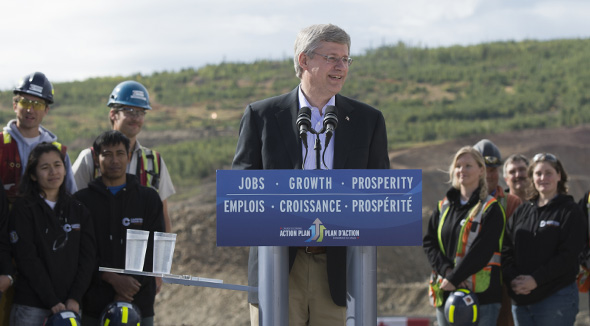
Prime Minister Harper at a press conference in the Yukon during his annual Northern tour (Government of Canada)

Prime Minister Stephen Harper says “tremendous economic opportunity” lies in tapping Canada’s northern resources, describing it as a key to the country’s prosperity. The comments came in a press conference in the Yukon, which he visited as part of his seventh annual Northern Tour.

The tour, which runs from August 20-24, is part of a long-term drive by the federal government to facilitate the development of resource projects in Canada.

The Prime Minister said the Canadian economy can outperform that of the United States, Japan and Europe by continuing to exploit its vast natural resources, much of which lies untapped in the North, and that there are more than 500 new development projects, worth half a trillion dollars, being proposed in the country over the next decade.

The Canadian economy is heavily reliant on natural resources, with $142.5 billion or 11.5 percent of Canada’s gross domestic product (GDP), and a staggering $200 billion in export revenue, amounting to over 50 percent of the net worth of all Canadian exports, being produced by the country’s resource sectors each year.

The announcement of a new Federal Skilled Trades Program (FSTP) last week by the Department of Immigration was largely a reaction to the growing demand for skilled workers like welders, boiler makers and heavy equipment operators in resource extraction hubs, particularly in western provinces like Alberta, as the country’s energy and mineral sectors have boomed, and ageing workers in the skilled trades have begun to retire in greater numbers.

Canadian Government Pushing Need for Pipeline Construction

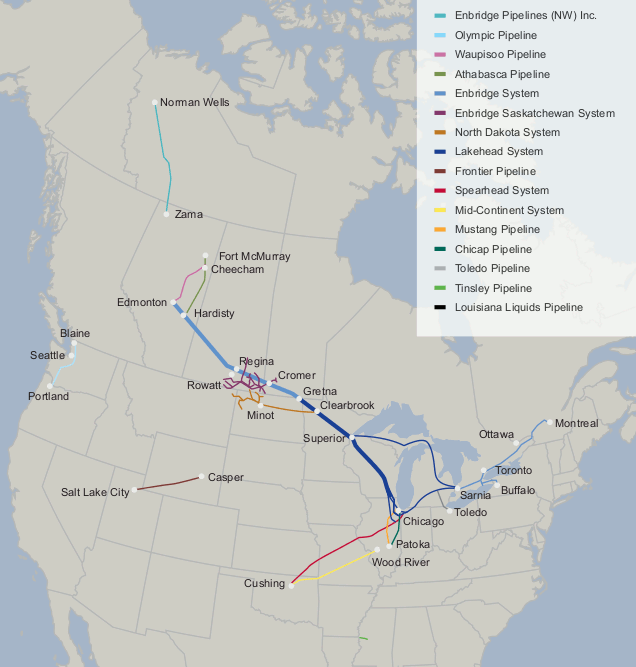
Canadian-based Enbridge Inc operates the largest pipeline system in the world. The company is hoping to get approval to build a pipeline from Alberta through British Columbia to the West Coast. (Enbridge Inc)

Federal Minister of Natural Resources Joe Oliver said that building more pipelines to Canada’s coasts and border is vital to the country’s economic well-being.

The Minister spoke to the Great Saskatoon Chamber of Commerce on Thursday, where he said that the success of Canada’s energy sector depends on the construction of more pipelines.

“Our government believes it is critical that Canada build pipelines west, south and east to ensure we have customers for our energy projects,” the Minister said at the luncheon.

The federal government in recent days has been defending the Enbridge Northern Gateway Pipelines Project, which is a plan to build a pipeline from Alberta to Canada’s Pacific coast to allow Canadian energy exports to Asia. The plan has faced criticism from a coalition of environmental groups and aboriginal activists, who say they don’t want a pipeline to go through British Columbia.

The government insists that transporting oil and gas by pipeline is the safest and cheapest method available, and that the country’s regulators have the tools necessary to keep the risks at acceptably low levels. Prime Minister Harper described the Enbridge pipeline this week as being “in the vital interests of Canada”.

The oil and gas industry, which depends on pipelines to transport its products, constitutes a major part of Canada’s natural resource sectors, which in turn produces over 50 percent of the country’s export revenues, amounting to over $200 billion in exports each year.

The resource sectors played a significant role in the average net worth of Canadian households surpassing that of American households for the first time in history last year, as rising commodity prices buoyed the value of the Canadian dollar.

Rate of Self-Employment Decreases for Sons of Immigrants, Increases for Daughters -Study

Self-employment rates of Canadian-born sons of immigrant parents are lower than that of their fathers, while those of Canadian-born daughters of immigrants are higher than that of their mothers' generation. (Eric Ward)

A study on intergenerational changes in self-employment rates among immigrant parents and their children finds that the Canadian-born sons of immigrant parents are less likely to be self-employed than their fathers, and are likely to choose self-employment for different reasons, while the Canadian-born daughters of immigrant parents are more likely to be self-employed than their mothers.

According to the Statistics Canada study, 12 percent of Canadian-born sons of immigrant parents aged 25 to 44 were self-employed in 2006, while 14 percent of immigrant fathers were self-employed at the same age in 1981. For Canadian-born daughters of immigrant parents, the self-employment rate increased to 7 percent, from 6 percent for their immigrant mothers in 1981.

The factors “pushing” individuals into self-employment differed between second generation and first generation men as well.

Among immigrant fathers in 1981, the main motivation for choosing self-employment was lack of employment opportunities, while among their Canadian born sons in 2006, there was a higher likelihood that expectations of greater earnings motivated them to choose self-employment.

The study finds that the generational decline in self-employment rates among the Canadian-born sons of immigrant parents is due to a larger trend in the typical life course events of Canadian men. Canadian men aged 25 to 44 have less work experience, are less likely to be married and have fewer children than their fathers when they were at their age.